



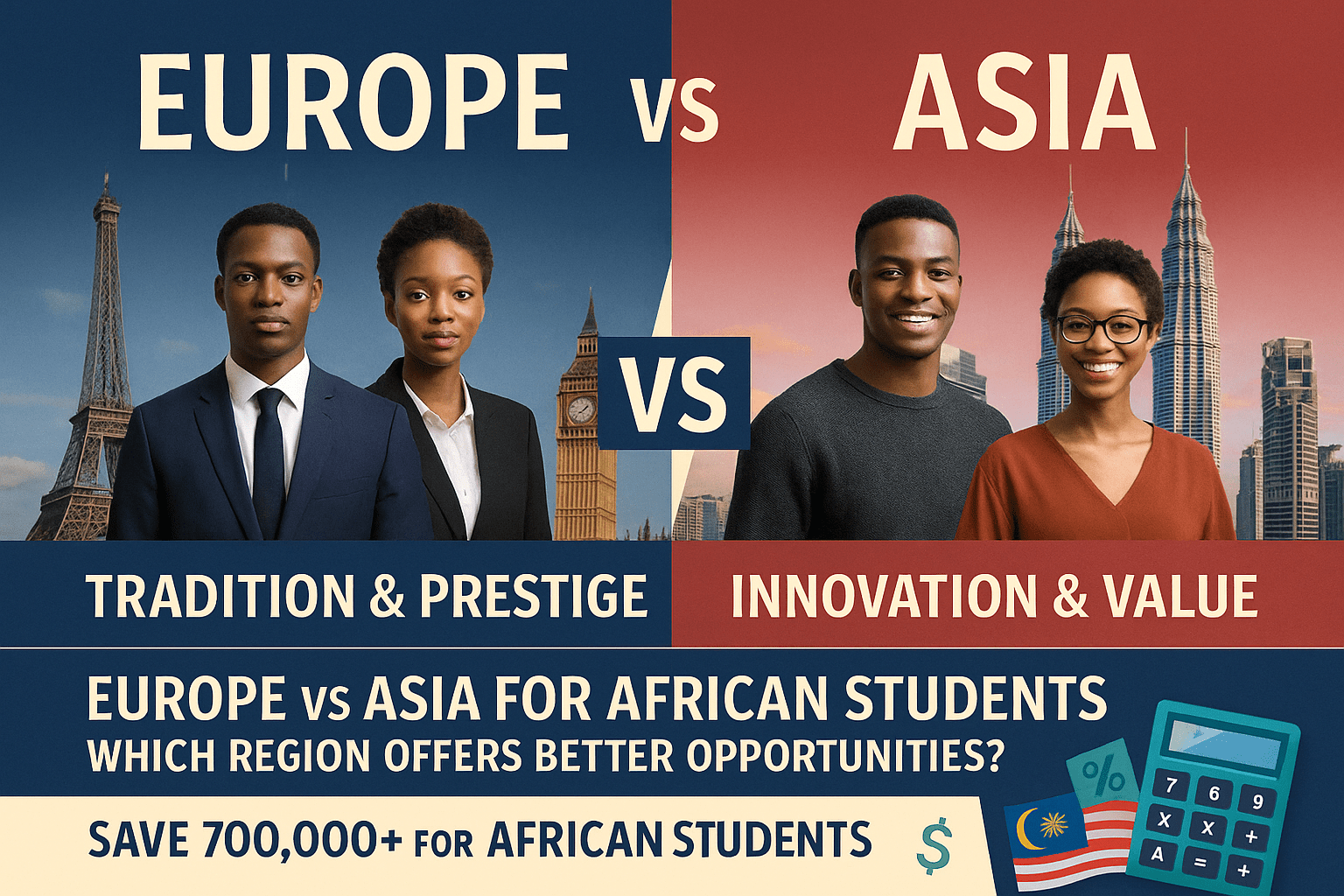
The choice between studying in Europe or Asia represents one of the most significant decisions facing African students seeking international education. Both regions offer world-class universities, diverse cultures, and promising career opportunities, but they cater to different priorities, budgets, and long-term goals.
With over 200,000 African students currently studying internationally, the traditional dominance of Western destinations is being challenged by Asia’s rapid rise as an education hub. Meanwhile, Europe continues to attract students with its rich history, research excellence, and post-graduation opportunities.
This comprehensive analysis examines both regions across critical factors that matter most to African students: cost, quality, career prospects, cultural fit, and long-term opportunities. By the end of this guide, you’ll have a clear framework for choosing the region that best aligns with your academic goals and life aspirations.
The key insight: Neither region is universally better – the right choice depends on your field of study, budget, career goals, and personal preferences.
Regional Overview: Two Worlds of Opportunity
Europe: The Traditional Powerhouse
Europe has long been the gold standard for international education, offering a unique combination of academic excellence, cultural diversity, and historical significance. With over 4,000 higher education institutions across 48 countries, Europe provides unparalleled variety in programs, languages, and experiences.
Key European Advantages:
- Academic Heritage: Home to some of the world’s oldest and most prestigious universities
- Research Excellence: Leading global research output and innovation
- Cultural Diversity: 200+ languages and rich historical heritage
- EU Integration: Freedom of movement and work across 27 countries
- Global Recognition: Degrees widely accepted worldwide
European Education Landscape:
- Student Population: 19.6 million students (including 1.7 million international)
- African Students: Approximately 180,000 across the continent
- Top Languages: English, German, French, Spanish, Italian
- Academic System: Bologna Process ensuring degree compatibility
Asia: The Rising Star
Asia has emerged as a dynamic education destination, combining rapid economic growth with increasing investment in higher education. The region offers modern facilities, competitive costs, and direct access to the world’s fastest-growing economies.
Key Asian Advantages:
- Economic Growth: Access to rapidly expanding job markets
- Cost Efficiency: Generally 40-60% lower costs than Europe
- Innovation Focus: Leading in technology and entrepreneurship
- Cultural Bridge: Gateway to understanding Asian markets
- Future Opportunities: Positioned for 21st-century economic dominance
Asian Education Landscape:
- Student Population: 25+ million students (including 1.2 million international)
- African Students: Approximately 85,000 across the region
- Top Languages: English, Mandarin, Japanese, Korean
- Academic Growth: Rapidly climbing global university rankings
Top Study Destinations: Europe vs Asia
Europe’s Premier Destinations
1. Germany – The Engineering Powerhouse
Why African Students Choose Germany:
- Free Education: No tuition fees at public universities
- Engineering Excellence: World-renowned technical programs
- Strong Economy: Europe’s largest economy with job opportunities
- Post-Study Work: 18-month job search visa for graduates
Popular Programs:
- Engineering (Mechanical, Electrical, Chemical)
- Computer Science and IT
- Business and Economics
- Medicine (competitive admission)
2. United Kingdom – The Academic Tradition
Strengths for African Students:
- Language Advantage: English-medium instruction
- Research Excellence: Home to Oxford, Cambridge, Imperial College
- Commonwealth Connections: Historical ties with many African countries
- Global Recognition: Degrees valued worldwide
Popular Programs:
- Business and Finance
- Law and International Relations
- Medicine and Health Sciences
- Engineering and Technology
3. France – Culture and Innovation
Appeal for African Students:
- Cultural Connections: Strong ties with Francophone Africa
- Affordable Education: Subsidized tuition for international students
- Research Opportunities: Leading in sciences and humanities
- Language Skills: Bilingual advantage in global job market
Popular Programs:
- Business and Management
- Engineering and Technology
- Arts and Humanities
- International Relations
4. Netherlands – Innovation Hub
Attractions for African Students:
- English Programs: Over 2,100 English-taught programs
- Innovation Focus: Leading in sustainability and technology
- Multicultural Environment: Highly international student body
- Strategic Location: Gateway to Europe
Popular Programs:
- Engineering and Technology
- Business and Economics
- Environmental Sciences
- Agriculture and Food Technology
Asia’s Leading Destinations
1. Malaysia – The Value Champion
Why African Students Love Malaysia:
- Unbeatable Value: 60-70% lower costs than Western alternatives
- Cultural Compatibility: Muslim-majority, multicultural society
- English Education: British system with English instruction
- Strategic Location: Gateway to Southeast Asia
Popular Programs:
- Engineering and Technology
- Business and Management
- Medicine and Health Sciences
- Information Technology
2. China – The Academic Giant
Strengths for African Students:
- Scholarship Programs: Extensive government funding
- Academic Growth: Rapidly improving university rankings
- Economic Opportunities: Access to world’s second-largest economy
- Language Skills: Mandarin opens Asian market doors
Popular Programs:
- Engineering and Technology
- Medicine (increasingly popular)
- Business and International Trade
- Chinese Language and Culture
3. Singapore – The Global Hub
Appeal for African Students:
- Global Rankings: NUS and NTU in top 20 globally
- Business Hub: Gateway to Asian markets
- Multicultural Society: Diverse, English-speaking environment
- Career Opportunities: Strong job market and high salaries
Popular Programs:
- Business and Finance
- Engineering and Technology
- Computer Science
- International Relations
Annual Costs:
- Tuition: $18,000-35,000
- Living Expenses: $12,000-18,000
- Total Annual Cost: $30,000-53,000
African Student Population: 3,000+
4. Japan – Technology and Innovation
Attractions for African Students:
- Technology Leadership: World-class engineering and science programs
- Cultural Experience: Unique cultural immersion opportunity
- Scholarship Opportunities: MEXT and university scholarships
- Research Excellence: Leading in technology and innovation
Popular Programs:
- Engineering and Technology
- Computer Science and Robotics
- Medicine and Life Sciences
- International Business
Annual Costs:
- Tuition: $6,000-18,000
- Living Expenses: $8,000-15,000
- Total Annual Cost: $14,000-33,000
African Student Population: 2,500+
Comprehensive Cost Analysis by Region
Europe: Investment in Prestige
Total 4-Year Degree Costs (Average):
Western Europe (High-Cost Countries):
- UK: $130,000-$310,000
- Switzerland: $120,000-$280,000
- Denmark: $80,000-$160,000
- Netherlands: $84,000-$150,000
Central Europe (Medium-Cost Countries):
- Germany: $44,000-$80,000 (public universities)
- Austria: $50,000-$90,000
- Czech Republic: $40,000-$70,000
- Poland: $35,000-$65,000
Southern Europe (Value Options):
- Portugal: $35,000-$65,000
- Spain: $40,000-$75,000
- Italy: $45,000-$80,000
- Greece: $30,000-$55,000
Eastern Europe (Budget-Friendly):
- Hungary: $25,000-$50,000
- Romania: $20,000-$45,000
- Bulgaria: $18,000-$40,000
- Estonia: $30,000-$55,000
Asia: Efficiency and Value
Total 4-Year Degree Costs (Average):
Southeast Asia (Best Value):
- Malaysia: $24,000-$72,000
- Thailand: $20,000-$50,000
- Philippines: $15,000-$35,000
- Indonesia: $12,000-$30,000
East Asia (Quality & Innovation):
- China: $24,000-$72,000
- South Korea: $40,000-$80,000
- Japan: $56,000-$132,000
- Taiwan: $30,000-$60,000
Developed Asia (Premium Options):
- Singapore: $120,000-$212,000
- Hong Kong: $80,000-$160,000
- Australia: $140,000-$240,000
South Asia (Emerging Markets):
- India: $15,000-$40,000
- Bangladesh: $10,000-$25,000
- Sri Lanka: $12,000-$30,000
Career Prospects and Job Market Analysis
Europe: Established Opportunities
Post-Graduation Work Rights:
- Germany: 18-month job search visa, permanent residency after 2 years
- Netherlands: 1-year orientation year, EU Blue Card opportunities
- France: 2-year temporary residence permit for job search
- UK: 2-year Graduate Route visa (3 years for PhD)
Salary Expectations (Entry-Level):
- Germany: €45,000-55,000 ($49,500-$60,500)
- Netherlands: €38,000-48,000 ($41,800-$52,800)
- France: €35,000-45,000 ($38,500-$49,500)
- UK: £25,000-35,000 ($30,750-$43,050)
Industry Strengths:
- Technology: Berlin, Amsterdam, London tech hubs
- Finance: London, Frankfurt, Zurich financial centers
- Engineering: German automotive and manufacturing
- Research: EU-wide research and development opportunities
- International Organizations: UN, EU, NATO headquartered in Europe
Career Growth Potential:
- EU Mobility: Work across 27 countries with single permit
- Global Companies: Access to European headquarters of multinationals
- Startup Ecosystem: Growing innovation hubs in major cities
- Academic Careers: Strong university and research sector
Asia: Dynamic Growth Markets
Post-Graduation Work Rights:
- Malaysia: 12-month Graduate Pass program
- Singapore: 1-year Training Employment Pass
- Japan: 1-year job-hunting visa
- China: Varies by city, generally 1-2 years
Salary Expectations (Entry-Level):
- Singapore: S$45,000-60,000 ($33,000-$44,000)
- Malaysia: RM 36,000-48,000 ($8,400-$11,200)
- China: ¥150,000-300,000 ($21,000-$42,000)
- Japan: ¥3,500,000-4,500,000 ($24,000-$31,000)
Industry Strengths:
- Technology: Rapid digitalization and AI development
- Manufacturing: Global supply chain opportunities
- Finance: Growing fintech and digital banking sectors
- E-commerce: Massive online marketplace growth
- Infrastructure: Major development projects across region
Emerging Opportunities:
- Belt and Road Initiative: Infrastructure projects connecting Asia-Africa
- Digital Economy: Leading global growth in tech sectors
- Green Energy: Massive investments in renewable energy
- Regional Trade: ASEAN economic integration creating opportunities
Cultural Considerations for African Students
Europe: Diversity Within Unity
Cultural Advantages:
- Multicultural Cities: London, Paris, Berlin host diverse communities
- African Diaspora: Established African communities in major cities
- Cultural Exchange: Rich history of cultural interaction
- Languages: Opportunity to learn multiple European languages
Cultural Challenges:
- Climate: Significant weather differences from most African countries
- Social Integration: Can be challenging in some countries
- Cultural Distance: Different social norms and communication styles
- Racism: Occasional discrimination, varies by country and region
Religious Considerations:
- Christianity: Strong Christian heritage and communities
- Islam: Growing Muslim communities, especially in France, Germany, UK
- Secularism: Generally secular societies with religious freedom
- Facilities: Prayer facilities and halal food increasingly available
Asia: Bridge Between Worlds
Cultural Advantages:
- Respect for Education: High value placed on academic achievement
- Community Orientation: Family and community values similar to Africa
- Religious Diversity: Buddhism, Islam, Christianity coexist
- Hospitality: Generally welcoming to international students
Cultural Challenges:
- Language Barriers: Limited English in some countries
- Social Hierarchy: Formal social structures can be challenging
- Cultural Adaptation: Significant differences in social norms
- Food Differences: Dietary adjustments may be necessary
Religious Considerations:
- Malaysia: Muslim-majority country with excellent Islamic facilities
- Singapore: Multi-religious society with strong tolerance
- China: Secular society with religious freedom limitations
- Japan: Primarily Buddhist/Shinto, very tolerant of other religions
Language Requirements Comparison
Europe: Multilingual Opportunities
English-Taught Programs:
- Netherlands: 2,100+ English programs
- Germany: 1,500+ English programs
- Sweden: 900+ English programs
- Denmark: 700+ English programs
Language Learning Benefits:
- Career Advantage: Multilingual skills valuable globally
- Cultural Integration: Language skills improve social integration
- EU Mobility: Language skills enable work across Europe
- Academic Access: Access to research in multiple languages
Language Requirements:
- English Programs: IELTS 6.0-7.0, TOEFL 80-100
- Native Language Programs: B2-C1 level proficiency required
- Language Support: Pre-session language courses available
- Integration Programs: Government-funded language classes
Asia: English Plus Local Languages
English-Medium Education:
- Malaysia: 90% of programs available in English
- Singapore: All programs taught in English
- Philippines: English as medium of instruction
- India: Many programs available in English
Local Language Benefits:
- Job Market: Local language skills improve employment prospects
- Cultural Understanding: Deeper integration into society
- Business Opportunities: Essential for local business development
- Long-term Settlement: Required for permanent residency
Language Support:
- Mandarin: Growing global importance for business
- Japanese: Valuable for technology and business careers
- Korean: Increasing relevance due to cultural exports
- Malay/Bahasa: Useful across Southeast Asia
Visa Policies and Immigration Pathways
Europe: Complex but Rewarding
Student Visa Requirements:
- Processing Time: 4-12 weeks depending on country
- Financial Proof: €8,000-15,000 required in bank account
- Health Insurance: Mandatory in most countries
- Academic Requirements: Varies by country and program
Post-Study Immigration:
- EU Blue Card: For highly skilled workers across EU
- National Schemes: Country-specific skilled migration programs
- Permanent Residency: Generally available after 5 years
- Citizenship: Possible after 5-10 years depending on country
Immigration Advantages:
- EU Mobility: Freedom to work across 27 countries
- Family Reunification: Bring spouse and children
- Social Benefits: Access to healthcare, education, social services
- Global Mobility: EU passport enables visa-free travel to 170+ countries
Asia: Streamlined and Efficient
Student Visa Requirements:
- Processing Time: 2-8 weeks for most countries
- Financial Proof: Generally lower requirements than Europe
- Health Requirements: Medical examination and insurance
- Simplified Process: Digital applications in most countries
Post-Study Opportunities:
- Work Permits: Generally easier to obtain than Europe
- Skilled Migration: Growing skilled worker programs
- Investment Visas: Opportunities for business development
- Regional Integration: ASEAN mobility initiatives
Long-term Prospects:
- Permanent Residency: Available in most countries after 3-5 years
- Business Opportunities: Easier to start businesses
- Regional Access: Strategic location for Asia-Pacific region
- Economic Growth: Benefit from rapid economic development
Regional Comparison: Decision Framework
Choose Europe If You:
Academic Priorities:
- Seek globally recognized prestigious degrees
- Want access to world-class research facilities
- Plan to pursue academic or research careers
- Value traditional academic excellence
Career Goals:
- Target multinational corporations
- Seek careers in international organizations
- Want to work across multiple countries
- Prefer established professional markets
Personal Preferences:
- Comfortable with higher education costs
- Enjoy cultural diversity and history
- Prefer temperate climates
- Value work-life balance culture
Long-term Plans:
- Want to settle in developed Western countries
- Seek EU citizenship and mobility rights
- Plan to work in traditional industries
- Prefer established social systems
Choose Asia If You:
Financial Considerations:
- Need cost-effective quality education
- Want to minimize education debt
- Seek good return on investment
- Prefer lower living costs
Career Aspirations:
- Target emerging market opportunities
- Want to be part of economic growth
- Seek entrepreneurship opportunities
- Plan to work in technology sectors
Cultural Factors:
- Comfortable adapting to new cultures
- Interested in Asian languages and cultures
- Want warm climate destinations
- Value community-oriented societies
Future Opportunities:
- Want to be positioned for Asia’s economic rise
- Seek business opportunities between Africa and Asia
- Plan to return to Africa with valuable skills
- Want to access fastest-growing job markets
Specific Recommendations by Field of Study
Engineering and Technology
- Europe: Germany, Netherlands for traditional engineering
- Asia: Malaysia, Singapore for modern technology focus
Business and Finance
- Europe: UK, Switzerland for international finance
- Asia: Singapore, Hong Kong for Asian markets
Medicine and Health Sciences
- Europe: Germany, France for research-focused medicine
- Asia: Malaysia, China for affordable medical education
Computer Science and IT
- Europe: Netherlands, UK for AI and fintech
- Asia: Singapore, Malaysia for software development
International Relations
- Europe: France, Belgium for diplomacy careers
- Asia: Singapore, Japan for Asia-Pacific focus
Making Your Decision: Action Steps
Step 1: Define Your Priorities
- Budget Assessment: Calculate total available funds
- Career Goals: Identify target industry and region
- Personal Preferences: Consider climate, culture, language
- Risk Tolerance: Evaluate comfort with new experiences
Step 2: Research Specific Opportunities
- University Rankings: Compare institutions in your field
- Scholarship Availability: Identify funding opportunities
- Alumni Networks: Connect with graduates in target careers
- Industry Trends: Research future job market prospects
Step 3: Financial Planning
- Total Cost Calculation: Include all expenses over degree duration
- Funding Sources: Identify scholarships, loans, family support
- Return on Investment: Calculate potential salary vs. education cost
- Exchange Rate Impact: Consider currency fluctuation risks
Step 4: Application Strategy
- Multiple Applications: Apply to both regions if undecided
- Backup Plans: Include safety school options
- Visa Requirements: Understand immigration requirements
- Timeline Planning: Coordinate application deadlines
Get Expert Guidance for Your Regional Choice
Choosing between Europe and Asia is a complex decision that impacts your entire future. At Afri Connection, we’ve helped over 500 African students navigate this choice, with our experts having firsthand experience in both regions.
Our Regional Consultation Service:
Comprehensive Assessment: ✅ Personal Goal Analysis: Understand your priorities and preferences
✅ Financial Evaluation: Realistic budget planning for both regions
✅ Career Pathway Mapping: Identify optimal paths in your field
✅ Cultural Fit Assessment: Determine best cultural match
Regional Expertise: ✅ Europe Specialists: Deep knowledge of EU education systems
✅ Asia Experts: Extensive experience with Asian universities
✅ Alumni Network: Connect with graduates from both regions
✅ Industry Insights: Current job market intelligence
Decision Support: ✅ Comparative Analysis: Side-by-side comparison for your situation
✅ Risk Assessment: Evaluate potential challenges and opportunities
✅ Application Strategy: Optimize applications for chosen region
✅ Ongoing Support: Guidance throughout your journey
Schedule Your Free Regional Consultation
🌍 Confused About Europe vs Asia? Get Expert Clarity
📞 Book Your Free 60-Minute Session.
Conclusion: Your Regional Gateway to Success
Both Europe and Asia offer exceptional opportunities for African students, but they serve different purposes and priorities. Europe provides prestige, established systems, and global recognition, while Asia offers innovation, value, and access to future growth markets.
The key to making the right choice lies in honest self-assessment: understanding your financial capacity, career goals, cultural preferences, and long-term vision. Remember that there’s no universally “correct” choice – only the choice that’s right for your unique circumstances.
Consider this: Your education destination shapes not just your degree, but your worldview, network, and life trajectory. Choose the region that aligns with who you are and who you want to become.
Ready to make an informed decision about your international education? Contact Afri Connection today for expert guidance tailored to your specific situation and goals.


